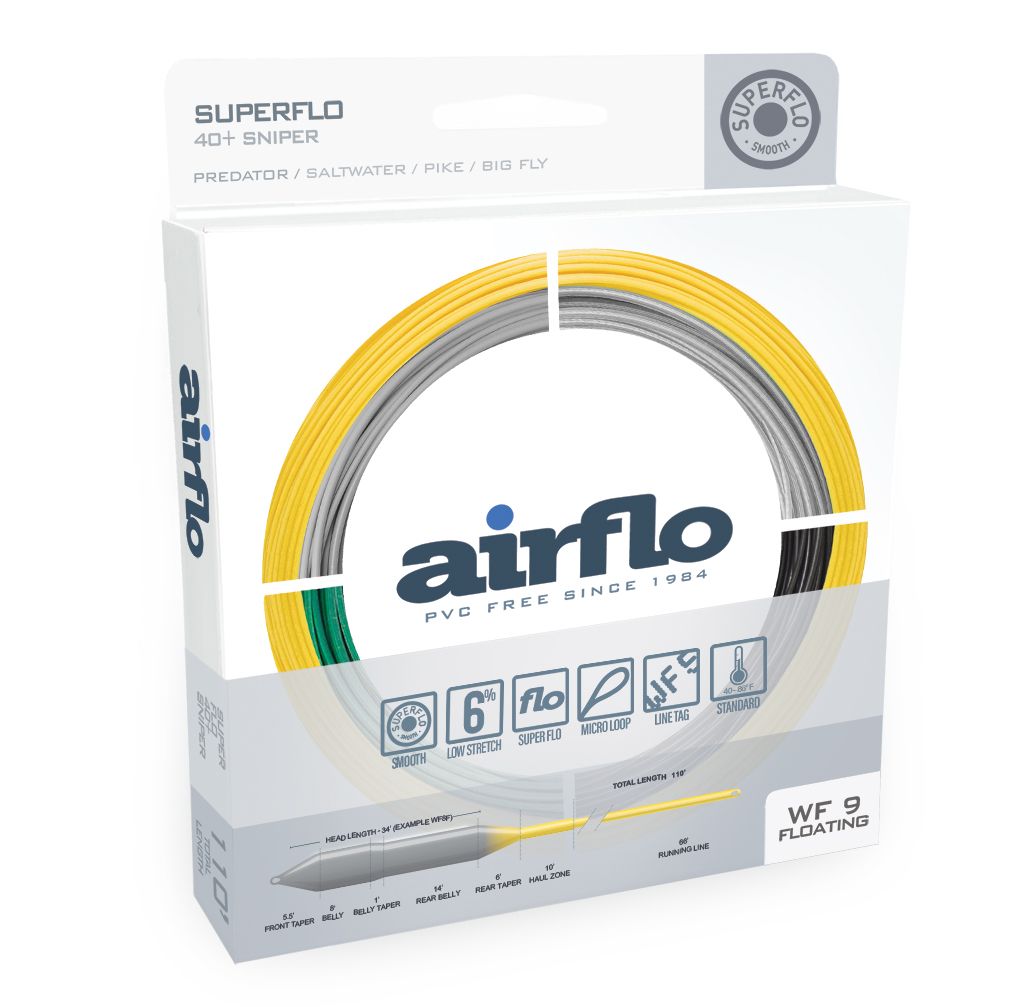
Photos: Airflo · supplied retailer imagery
Predator tackle · Pike fly lines · Our take
Airflo Pike Fly Line
Airflo Pike Fly Line
A proper predator fly line built to turn over bulky pike flies, with four density options and enough grunt for serious stillwater and river work.
- Available in Floating, Fast Intermediate, Di3 and Di7 densities.
- Available in WF8, WF9 and WF10 line weights.
- Head weights run from 330 grains / 21.4g in WF8 to 425 grains / 27.5g in WF10.
- The line is 110ft / 33.5m long, with looped ends and laser identification tagging.
Make sure it’s the right one. This review covers the Airflo Pike Fly Line in its Floating, Fast Intermediate, Di3 and Di7 options, across WF8, WF9 and WF10.
Tackle Index Score
Tackle Index score
A focused, versatile pike line with plenty of casting authority and useful density choices.
Desk-research score from specs, price and fishing fit · How we score
- Product Quality9/10
- Performance9.2/10
- Impact on Fish Catching8.9/10
- Ease of Use8.6/10
- Value for Money8.8/10
Price alerts are coming soon — we don't track live retailer prices yet, so we'll never guess one.
If you buy through our links, we might get a small kickback, but it won’t cost you a penny extra. As an Amazon Associate I earn from qualifying purchases. The full story
Who it suits
Is it right for you?
Great for
- Pike fly anglers throwing big, bulky patterns. The heavier predator-focused head is designed to turn over flies that would leave a lighter general-purpose line wheezing.
- Anglers covering different depths through the season. Four density choices let you match the line to shallow weed, open midwater or deeper features.
Maybe skip if
- Trout anglers wanting a delicate all-rounder. This is built for predator work and will feel needlessly beefy on small flies and lighter tackle.
- Anyone using a rod that doesn’t match the line weight. The WF8-WF10 options carry serious head weight, so a mismatched outfit can become hard work and a bit clumsy.
The lowdown
Introducing the Airflo Pike Fly Line
A proper predator fly line built to turn over bulky pike flies, with four density options and enough grunt for serious stillwater and river work.
- Available in Floating, Fast Intermediate, Di3 and Di7 densities.
- Available in WF8, WF9 and WF10 line weights.
- Head weights run from 330 grains / 21.4g in WF8 to 425 grains / 27.5g in WF10.
- The line is 110ft / 33.5m long, with looped ends and laser identification tagging.
Quick verdict
Verdict
If pike fly fishing means launching big, wind-resistant flies rather than delicate little dries, this line makes a lot of sense. It’s built around turnover, control and getting the fly into the depth you actually want.
The choice of density is the big win. Floating keeps things simple, while Fast Intermediate, Di3 and Di7 give you proper options when pike drop deeper or the water column needs covering. A cracking, purposeful line rather than a jack-of-all-trades floaty number.
A focused, versatile pike line with plenty of casting authority and useful density choices.
Desk-research score from specs, price and fishing fit · How we score
- Product Quality
- 9/10
- Performance
- 9.2/10
- Impact on Fish Catching
- 8.9/10
- Ease of Use
- 8.6/10
- Value for Money
- 8.8/10
The looped ends, laser identification and 30lb braided core make it a well-equipped specialist line.
The substantial heads and predator-focused options are well suited to turning over bulky flies.
Choosing the right density can put the fly in the pike’s feeding zone for longer and improve depth control.
The loops and clear density range reduce faff, although heavy lines and flies still demand a matched outfit.
One properly chosen line gives you a clear, capable tool for a defined job, with four density routes across the range.
Head to head
How it stacks up
Side by side with the closest kit we've reviewed. This updates as we add more reviews.
Airflo
Airflo Pike Fly Line (this one)
Top scorer
Scores are our own, out of 10. Best in each row is in green. Prices change, so check the latest before you buy.
The full rundown
Everything you'll want to know about the Airflo Pike Fly Line
Pike fly fishing isn’t really about dainty little flicks and hoping a trout sips your offering. You’re often lobbing a proper mouthful of feathers, fur, flash and synthetic fibres. Add a chunky wire trace or heavy leader and the whole lot can feel like casting a wet tea towel. That’s where the Airflo Pike Fly Line earns its keep. It’s made for predator anglers who want the line to do the heavy lifting when a big fly needs turning over.
The first thing to get your head around is that this isn’t one single line in one single density. You’ve got Floating, Fast Intermediate, Di3 and Di7 options, so there’s a version for working different parts of the water column. That’s proper useful on UK waters, where pike can be tucked into shallow weed one day and sitting over a deeper shelf the next. Swapping lines can be far more effective than endlessly changing flies and wondering why nothing’s happening.
The Floating version is the obvious starting point for a lot of anglers. Fish it around reed beds, shallow bays, weed tops and margins, especially when the pike are looking up or the water is warm and relatively clear. It keeps the fly high, helps you control a fly around cover and makes it easier to track what’s happening during the retrieve. For searching a new swim, that’s a cracking place to begin.
Fast Intermediate gives you a little more depth without going full submarine. Its sink rate is 1.5 inches per second, so it can get a fly below the surface film while still allowing a fairly natural, manageable retrieve. That’s handy when fish aren’t right in the upper layer but you don’t want to drag your fly through the silt. Count the line down, keep the retrieve consistent and let the water tell you where the pike are sitting.
Then come the Di3 and Di7 options. Di3 sinks at 3.0 inches per second, while Di7 drops at 7.0 inches per second. The faster-sinking line is aimed at really getting down, whether that means deep pits, reservoirs, winter swims or a strong wind pushing surface water about. It’s not a line to pick just because the number looks impressive, mind. Match the density to the depth and retrieve, or you’ll spend half the session hanging up and losing contact.
The head lengths are sensibly set up for this sort of work. Floating and Fast Intermediate have a 31-foot, or 9.2-metre, head. Di3 and Di7 use a shorter 28-foot, or 8.5-metre, head. That shorter sinking head can help keep the casting stroke compact when you’re working heavier flies and trying to stay in touch with the line. Less faff in the air is never a bad thing when the wind’s having a proper tantrum.
Line weight matters here too. The range covers WF8, WF9 and WF10, with full-head weights of 330 grains, 375 grains and 425 grains respectively. In old money, that’s roughly 21.4g, 24g and 27.5g. Those are serious chunks of line, designed to load suitable predator rods and turn over flies with some authority. Don’t chuck one on any old fly rod and expect a smooth day out. Match the outfit properly, mate.
The 30lb braided core gives the line a strong predator-minded backbone, while loops at both ends make the practical jobs easier. You can connect backing at the rear and a leader or bite-trace setup at the front without faffing around with nail knots every time you change something. The laser tagging is another small but useful touch, helping you identify the line when several reels or spare spools are lying in the bag.
In use, the smart approach is to think of this line as part of a system. Your rod, fly, leader, trace and retrieve all need to pull in the same direction. A big fly on a floating WF8 may be perfect around shallow cover, while the same pattern on a Di7 WF10 could be the ticket over deep water. Keep the casting stroke smooth, avoid trying to belt the fly into orbit and let the head load the rod. That’s when this line should feel properly at home.
The trade-off is straightforward. A line with this much purpose won’t be the delicate choice for every fly fishing job, and heavy predator tackle can tire you out if you spend all day false casting. But that’s not really a mark against it. If your target is pike and your flies are big enough to make a trout angler raise an eyebrow, the Airflo Pike Fly Line looks bang on the money as a focused, flexible tool.
Specifications
The nuts and bolts
- Line weights
- WF8, WF9 and WF10
- Densities
- Floating, Fast Intermediate, Di3 and Di7
- Total length
- 110ft / 33.5m
- Head length
- 31ft / 9.2m for Floating and Fast Intermediate; 28ft / 8.5m for Di3 and Di7
- Core
- 30lb braid
- End details
- Looped at both ends; laser-tagged for identification
Specs checked with Airflo, Oct 2026.
Spot a model or spec change?
Our take
The angle
This is all about making large predator flies manageable. The heavier head and pike-focused profile are aimed at loading a suitable fly rod quickly, turning over bulky patterns and keeping the cast from becoming a sweaty battle.
For UK pike fishing, that versatility matters. You can fish shallow bays and weed edges with the Floating version, search midwater with Fast Intermediate or Di3, then get properly deep with Di7. Pick the density to suit the swim, not just the forecast.
Closer look
A predator line with proper options
The Airflo Pike Fly Line is available in Floating, Fast Intermediate, Di3 and Di7 densities, with WF8, WF9 and WF10 line weights. That gives you a useful spread, from shallow-water work through to deep searching. The Floating and Fast Intermediate versions have a 31ft / 9.2m head, while Di3 and Di7 use a 28ft / 8.5m head.
The full-head weights are substantial: 330 grains / 21.4g for WF8, 375 grains / 24g for WF9 and 425 grains / 27.5g for WF10. That’s the sort of mass you want when a big pike fly needs turning over. The line has a 30lb braided core, loops at both ends and laser tagging for quick identification.
Worth knowing. Sink rates are 1.5 inches per second for Fast Intermediate, 3.0 inches per second for Di3 and 7.0 inches per second for Di7. Count the line down before retrieving, especially in a new swim, so the fly fishes where you think it does.
Who it suits
Built for big flies and changing depths
This line suits the angler who’s fishing flies that need a proper shove to get moving. Large streamers, bulky baitfish patterns and wind-resistant predator flies are much easier to manage when the head carries enough weight to load the rod and turn over the leader.
It’s also a strong choice if you fish more than one type of water. Floating works around shallow weed and margins, Fast Intermediate covers the upper midwater, and the Di3 or Di7 can get you down over deeper features. That flexibility can save you carrying several wildly different setups.
It’s less suited to delicate trout presentation or anyone wanting one line for every kind of fly fishing. The whole point here is power and control with predator tackle. Used with the right rod and a sensible retrieve, that focus is a benefit rather than a limitation.
FAQs in full
The useful bits before you spool up
Is the Floating version best for shallow pike? Usually, yes. It keeps the fly up around weed, reeds and margins, and it’s a straightforward option when fish are hunting high in the water. Add a suitable leader and bite protection, then work the fly with pauses around cover.
When should you use Di7? Pick it when you genuinely need to fish deep. It sinks at 7.0 inches per second, so it can reach deeper water far quicker than the Floating or Fast Intermediate versions. Keep an eye on snags and don’t let the fly trundle along the bottom unless that’s deliberate.
How do you choose between WF8, WF9 and WF10? Start with the rod and fly sizes you plan to use. WF8 carries 330 grains / 21.4g, WF9 carries 375 grains / 24g and WF10 carries 425 grains / 27.5g. Bigger isn’t automatically better; the best option is the one your rod is designed to handle smoothly.
On paper
Pros & cons
What we like
- Properly geared for bulky pike and predator flies.
- Four densities cover shallow, midwater and deep presentations.
- Looped at both ends makes leader and backing changes dead handy.
- Clearly identified line options help avoid a rummage in the tackle bag.
Worth knowing
- A specialist predator line, so it’s overkill for general trout-style fly work.
- The heavier head needs a rod and casting stroke that can handle the chosen line weight.
- Large flies, heavy leaders and deep densities can still make a session tiring if you’re constantly false casting.
Want one?
Add it to your Wanted list or join a Group Buy — shops see anonymous totals only.
Your questions answered
What anglers want to know
The stuff you’d ask your mate on the next peg. Straight answers, no waffle.
01Which Airflo Pike Fly Line density should I choose?
Which Airflo Pike Fly Line density should I choose?
Floating is the straightforward option for shallow water, surface work and flies fished around weed. Fast Intermediate gives a steady, controlled descent, while Di3 and Di7 are the choices when you need to search deeper water.
02What size pike fly rod suits this line?
What size pike fly rod suits this line?
The line is offered in WF8, WF9 and WF10, so match the line weight to a suitable predator fly rod rather than simply picking the heaviest option. The rod, fly size and leader all need to work together.
03Is the line suitable for large pike flies?
Is the line suitable for large pike flies?
That’s exactly the job. The head is designed to cast large, bulky flies, giving you the mass and turnover needed to get big patterns moving without endless false casting.
What anglers say
The word from the bank
Our read: verdict. The strongest reasons to choose it are properly geared for bulky pike and predator flies. and four densities cover shallow, midwater and deep presentations.; the main trade-off is a specialist predator line, so it’s overkill for general trout-style fly work..
Our take on the feedback
Why it appeals
Checked Sept '26 — “Properly geared for bulky pike and predator flies.”
Best fit
Checked Sept '26 — “Pike fly anglers throwing big, bulky patterns: The heavier predator-focused head is designed to turn over flies that would leave a lighter general-purpose line wheezing.”
Worth knowing
Checked Sept '26 — “A specialist predator line, so it’s overkill for general trout-style fly work.”
Tackle Index’s take from the product details and fishing fit we checked. We haven’t found enough independent public feedback to call this an angler consensus yet.
Angler score
What our readers rate Airflo Pike Fly Line
No angler score yet — nobody's reviewed Airflo Pike Fly Line here. Be the first and get the score started.
Owner reports
Own this? Help the next angler.
Quick multiple-choice reports from people who say they own the Airflo Pike Fly Line. Not verified purchases, and kept separate from our score.
No owner reports yet.
Alternatives & go-withs