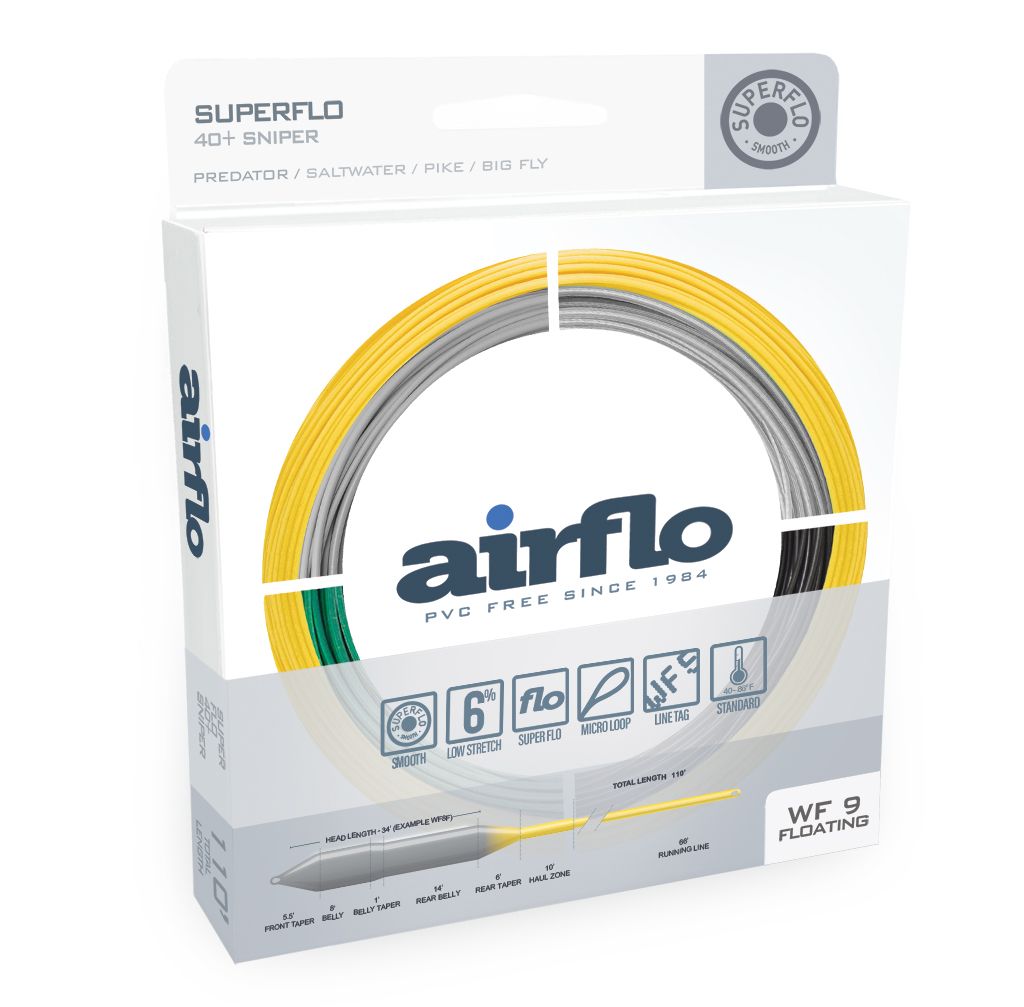
Photos: Airflo · supplied retailer imagery
Predator fly fishing · Fly lines · Our take
Airflo Predator Fly Line
WF8–WF10 · Floating, fast intermediate, Di3 and Di7
A chunky predator fly line built to turn over bulky pike flies, reach the depth and keep casting when dainty trout tackle just won’t cut it.
- Available in WF8, WF9 and WF10 line weights for throwing substantial predator flies.
- Density options include floating, fast intermediate, Di3 and Di7.
- Fast intermediate sinks at approximately 1.5 inches per second; Di3 at 3 inches per second; Di7 at 7 inches per second.
- Floating and fast-intermediate heads are approximately 31ft long, while Di3 and Di7 heads are approximately 28ft.
Make sure it’s the right one. This is the Airflo Predator Fly Line, not a conventional carp or coarse-fishing mainline. It’s a dedicated fly line for casting large predator flies to pike and other toothy freshwater or saltwater fish.
Tackle Index Score
Tackle Index score
A focused predator fly line with a useful spread of densities and enough specification detail to build a serious pike outfit.
Desk-research score from specs, price and fishing fit · How we score
- Product Quality8.8/10
- Performance9.1/10
- Impact on Fish Catching8.9/10
- Ease of Use8.6/10
- Value for Money8.6/10
Price alerts are coming soon — we don't track live retailer prices yet, so we'll never guess one.
If you buy through our links, we might get a small kickback, but it won’t cost you a penny extra. As an Amazon Associate I earn from qualifying purchases. The full story
Who it suits
Is it right for you?
Great for
- Pike fly anglers throwing big streamers. The short, powerful head is intended to turn over bulky flies without making every cast a complete faff.
- Anglers fishing different depths. Floating, intermediate, Di3 and Di7 versions let you adapt to weed, margins, drop-offs and deeper water.
Maybe skip if
- Trout anglers using small or delicate flies. This is predator tackle with grunt, not a subtle presentation line for tiny dries.
- Anyone wanting one line for every fly-fishing job. The Airflo Predator is purpose-built, so its strengths are tied to big flies and hard-fighting predators.
The lowdown
Introducing the Airflo Predator Fly Line
A chunky predator fly line built to turn over bulky pike flies, reach the depth and keep casting when dainty trout tackle just won’t cut it.
- Available in WF8, WF9 and WF10 line weights for throwing substantial predator flies.
- Density options include floating, fast intermediate, Di3 and Di7.
- Fast intermediate sinks at approximately 1.5 inches per second; Di3 at 3 inches per second; Di7 at 7 inches per second.
- Floating and fast-intermediate heads are approximately 31ft long, while Di3 and Di7 heads are approximately 28ft.
Quick verdict
Verdict
If you’re chucking big pike flies, this line makes far more sense than trying to bully them out with a standard trout taper. The front end is built to turn over bulky patterns, while the range of densities lets you fish more than just the top layer.
It’s specialised rather than cheap-and-cheerful general-purpose kit. Pick the right weight and sink rate for your rod and water, and it looks like a cracking tool for serious predator fly work.
A focused predator fly line with a useful spread of densities and enough specification detail to build a serious pike outfit.
Desk-research score from specs, price and fishing fit · How we score
- Product Quality
- 8.8/10
- Performance
- 9.1/10
- Impact on Fish Catching
- 8.9/10
- Ease of Use
- 8.6/10
- Value for Money
- 8.6/10
Purpose-built features such as laser tagging, strong-core construction and welded or looped connection options suggest a well-considered predator line.
The compact head lengths, heavyweight options and dedicated sinking choices are geared towards powerful casts with bulky flies.
Being able to present a large fly at different depths can make a proper difference when pike are not sitting in the top layer.
The identification tag and loops are handy, though matching line weight, density and countdown takes a bit of learning.
It offers a broad, specialist range for predator anglers, but the value depends on whether you’ll actually use the extra density options.
Head to head
How it stacks up
Side by side with the closest kit we've reviewed. This updates as we add more reviews.
Airflo
Airflo Predator Fly Line (this one)
Top scorer
Scores are our own, out of 10. Best in each row is in green. Prices change, so check the latest before you buy.
The full rundown
Everything you'll want to know about the Airflo Predator Fly Line
Big flies and delicate trout lines don’t always get on, do they? You can have the fanciest pike pattern in the box, but if the line can’t turn it over, the cast becomes a tangled bit of drama. That’s where the Airflo Predator Fly Line comes in. It’s built for launching bulky predator flies with a bit of authority, rather than wafting small dries about like you’re after a shy grayling.
The range comes in WF8, WF9 and WF10, giving you proper heavyweight options for predator rods. That’s the sort of class you’d expect when pike, perch or saltwater predators are on the menu and the flies have plenty of dressing, wire, eyes and flash. In other words, this isn’t a dainty line for flicking a size 16 nymph under an overhanging tree. It’s made for a bigger bosh.
The taper is designed around carrying bulky flies and casting them long. That matters on a big reservoir, a windswept lake or a wide canal where the pike aren’t always tucked under your boots. A line with a purposeful head helps load the rod quickly, and gives the fly enough turnover to straighten the leader rather than collapsing in a heap halfway out.
You can choose from floating, fast intermediate, Di3 and Di7 densities. The floating option is the obvious starting point for shallow water, surface disturbance and working a fly over weed. It also gives you the easiest line control when you’re learning the outfit. Keep the rod tip high or low, mend where needed and you can alter the fly’s angle without adding another layer of faff.
The fast intermediate sinks at roughly 1.5 inches per second, so it’s a useful middle ground. It can get a fly just under the surface film and down through the upper water without plummeting straight into the cabbage. That’s handy when fish are following but not quite committing, or when the wind is pushing a floating line around like a crisp packet.
When the fish are sitting lower, Di3 and Di7 give you more downwards pull. Di3 sinks at about 3 inches per second, while Di7 is around 7 inches per second. Those aren’t magic numbers for every situation, as fly size, leader and retrieve all alter the picture, but they give you a sensible starting point for counting the line down before beginning the retrieve.
The floating and fast-intermediate heads are approximately 31ft long, while the Di3 and Di7 heads are around 28ft. That slightly shorter sinking head makes sense for predator work: you’re looking for a compact, punchy casting load when the fly is big and conditions aren’t always lovely. It should also feel more manageable when you’re making repeated casts from a tight bank swim or boat.
The floating WF8 head is listed at 330 grains, the WF9 at 375 grains and the WF10 at 425 grains. Those are serious loads, so check your rod rating before ordering. Match the line to the outfit, not just the size of the pike fly. Too light and turnover suffers; too heavy and you can make the rod feel clumsy, especially after a full day of searching water.
The line is approximately 110ft long and uses a 30lb braided core or Power Core, depending on the retailer’s listing. Both ends are looped on some versions, while certain sinking variants are looped at the rear only. There’s also laser tagging for identification, which sounds minor until you’ve got several similar-looking lines in the kit bag and need the Di7 rather than the floater, pronto.
Specifications
The nuts and bolts
- Line weights
- WF8, WF9 and WF10
- Density options
- Floating, fast intermediate, Di3 and Di7
- Sink rates
- Fast intermediate approx. 1.5ips; Di3 approx. 3ips; Di7 approx. 7ips
- Head length
- Floating and fast intermediate approx. 31ft; Di3 and Di7 approx. 28ft
- Total length
- Approximately 110ft / 33.5m
- Core and connections
- 30lb braided core or Power Core, depending on listing; looped ends or rear loop on some sinking variants
Specs checked with Airflo, Oct 2026.
Spot a model or spec change?
Our take
The big-fly angle
The whole point here is control. Big streamers, articulated pike flies and flashy saltwater patterns need a line with enough authority to load the rod and straighten the leader. The Airflo Predator is aimed squarely at that job.
You get floating, fast intermediate, Di3 and Di7 options, so you can cover shallow weed, the drop-off and deeper water without constantly forcing one line to do everything. That’s handy when the pike are mooching at different levels.
What you’re buying
A predator line with proper pulling power
Airflo has kept the job fairly clear here: cast big flies, cover distance and fish different depths. The WF8 to WF10 range gives you enough grunt for pike patterns and other chunky predator offerings, while the head lengths stay compact enough to load a suitable rod without endless false casting.
The floating and fast-intermediate heads are approximately 31ft, with the Di3 and Di7 heads around 28ft. Total line length is approximately 110ft. The laser-tagged identification is a small but genuinely useful touch when your reel bag contains several lines that all look vaguely similar.
Worth knowing. The core is described as 30lb braided core or Power Core depending on the retailer listing. Connection details can also vary: some lines are looped at both ends, while some sinking versions are looped at the rear only. Check the exact variant before buying.
On the water
Pick the density for the swim
The floater suits shallow margins, weedbeds and top-layer work. Fast intermediate is the handy all-rounder when you want to get below the surface without burying the fly. Count it down, keep the retrieve moving and watch for that sudden line tick that says a pike has had a cheeky nip.
Di3 is useful when fish are holding deeper or the wind is lifting the floating line. Di7 is the proper depth-finder for deeper water and steep drop-offs. Make a count-down routine part of the session: cast, let the line settle, then start at different depths until you find where the predators are on the munch.
This line makes most sense on a suitable WF8, WF9 or WF10 predator rod. Use a reliable bite-resistant leader and keep your casting stroke smooth. Big flies can snag the air, so avoid frantic false casting and give the head room to work. Your shoulder will thank you by the end of a long search session.
Quick answers
The bits you’ll want clear
Choose the weight that matches your rod’s rating and the flies you normally use. A heavier line isn’t automatically better. The rod needs to load comfortably, otherwise the outfit can feel clunky and tiring rather than powerful.
Sink rates are approximate rather than a promise carved in stone. Fly profile, leader, retrieve speed, water temperature and line angle all make a difference. Use them as a guide, then adjust your countdown until the fly is travelling through the productive layer.
For saltwater use, rinse the line and connection points in fresh water after the session. That simple bit of aftercare helps keep grit and salt from turning a cracking predator line into a sticky, awkward mess.
On paper
Pros & cons
What we like
- Designed specifically to turn over bulky predator flies.
- Four density choices cover surface, upper-water and deeper presentations.
- Laser tagging makes line identification quick and dead handy.
- Looped connections make leader and backing changes less of a faff.
Worth knowing
- A specialist line, so it’s overkill for normal trout or delicate small-fly work.
- You’ll need to match the WF rating and density properly to your rod and venue.
- Some sinking variants may only be looped at the rear, depending on the exact line listing.
Want one?
Add it to your Wanted list or join a Group Buy — shops see anonymous totals only.
Your questions answered
What anglers want to know
The stuff you’d ask your mate on the next peg. Straight answers, no waffle.
01Which Airflo Predator line weight should I choose?
Which Airflo Predator line weight should I choose?
Match the line weight to your fly rod’s rating first. WF8, WF9 and WF10 are all aimed at substantial predator outfits, but the correct choice depends on the rod and the size of fly you’re casting. Don’t simply go heavier because the fly looks massive.
02What do Di3 and Di7 mean?
What do Di3 and Di7 mean?
They describe sinking density and approximate sink rate. Di3 sinks at around 3 inches per second, while Di7 sinks at around 7 inches per second. Count it down after the cast, then keep the fly moving at the depth where the pike are sitting.
03Is it suitable for saltwater predators?
Is it suitable for saltwater predators?
The line is listed as suitable for toothy freshwater and saltwater predators. Rinse the line and connections with fresh water after saltwater use, and pay close attention to the manufacturer’s care guidance.
What anglers say
The word from the bank
Our read: verdict. The strongest reasons to choose it are designed specifically to turn over bulky predator flies. and four density choices cover surface, upper-water and deeper presentations.; the main trade-off is a specialist line, so it’s overkill for normal trout or delicate small-fly work..
Our take on the feedback
Why it appeals
Checked Sept '26 — “Designed specifically to turn over bulky predator flies.”
Best fit
Checked Sept '26 — “Pike fly anglers throwing big streamers: The short, powerful head is intended to turn over bulky flies without making every cast a complete faff.”
Worth knowing
Checked Sept '26 — “A specialist line, so it’s overkill for normal trout or delicate small-fly work.”
Tackle Index’s take from the product details and fishing fit we checked. We haven’t found enough independent public feedback to call this an angler consensus yet.
Angler score
What our readers rate Airflo Predator Fly Line
No angler score yet — nobody's reviewed Airflo Predator Fly Line here. Be the first and get the score started.
Owner reports
Own this? Help the next angler.
Quick multiple-choice reports from people who say they own the Airflo Predator Fly Line. Not verified purchases, and kept separate from our score.
No owner reports yet.
Alternatives & go-withs